A Map Drawn on Black
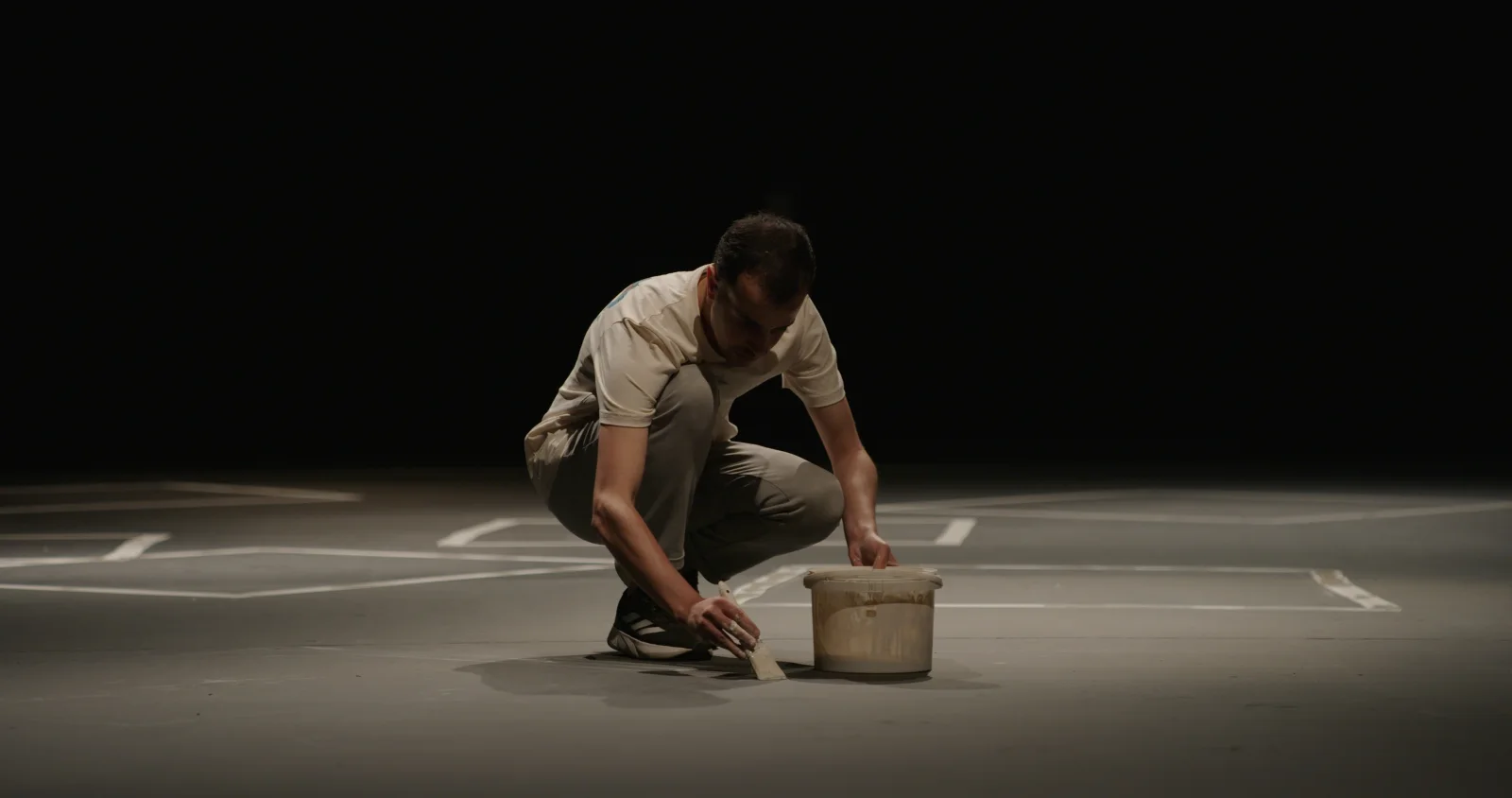
At the beginning of Who Is Still Alive, there is almost nothing.
A black floor.
White paint.
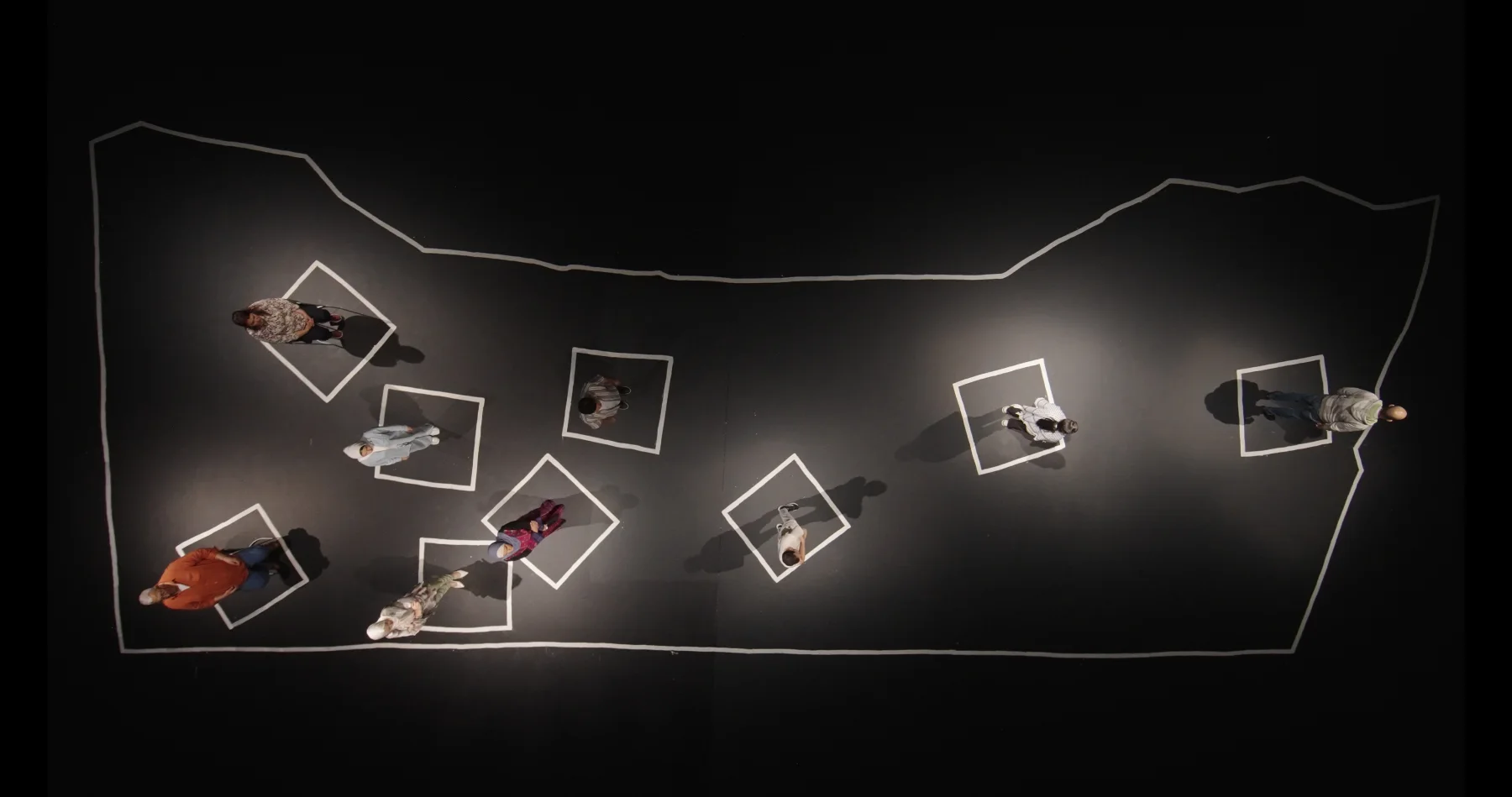
A map of Gaza.
Cities, camps and neighbourhoods reduced to a few outlines, as though someone had tried to reconstruct a country with the materials of a classroom after the school itself had disappeared.
One thinks of Dogville, inevitably. In Lars von Trier’s film, walls were replaced by lines traced on the floor, and the imagination was asked to supply the rest.
Nicolas Wadimoff makes a similar gesture here, though one infinitely less playful.
He does not strip away the set in order to draw our attention to the device.
He strips it away so that nothing can shield us from the testimony.
Nine Palestinians who managed to leave Gaza occupy this rudimentary geography. Five women, four men. Each comes from a different place, each carrying a private city within the collective one: Gaza City, Rafah, Khan Younis, Nuseirat, Deir al-Balah, Tel al-Hawa, and other places, some of them since profoundly destroyed or transformed.
The map almost resembles a child’s hopscotch grid.
Nobody particularly wants to play.
What Images Can No Longer Show
Wadimoff could have filled his film with archive footage.
We know those images.
Or rather, we think we do.
Buildings collapsing. Bodies carried through the dust. Screams. Rubble. Then another image replaces the previous one on a phone before our nervous system has finished understanding the first.
We now experience this saturation almost daily.
Who Is Still Alive reverses the movement: the image ceases to be information and becomes a human being again.
That is where the film’s radical simplicity begins.
No compulsory illustration.
No bombardment placed over a sentence to inform us that the sentence matters.
Speech produces its own images.
And sometimes the absence of an image becomes harder to bear than the image itself.
Wadimoff has said that he wanted to return to a “human measure” of catastrophe, making speech, rather than the accumulation of unbearable images, the material of the film.
It is a form of trust increasingly rare in cinema: the belief that a face remembering may be enough.
Nine People, Not Nine Symbols
The film becomes political in a rather singular way: by refusing to reduce its protagonists to political functions.
Eman is a doctor who devoted part of her life to helping women with cancer.
Mahmoud writes poetry.
Ghada is fourteen and dreams of medical research.
Adel draws.
Haneen is a journalist.
Jawdat collected antiquities and created a palm grove and cactus garden with his wife.
Hana runs a communications agency.
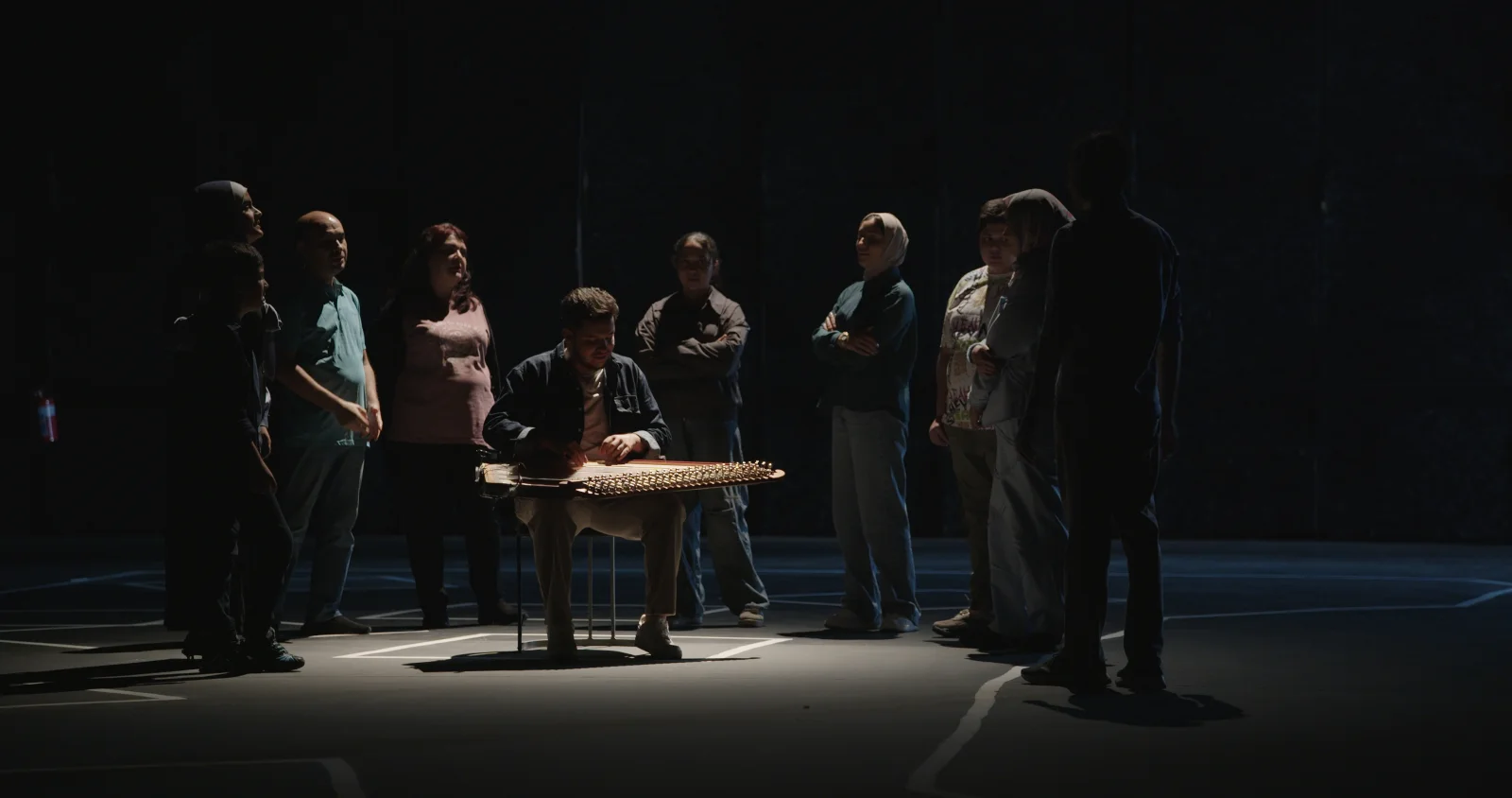
Feras plays the qanun.
Malak is twenty-one and has tens of thousands of followers on Instagram.
It seems almost absurd that any of this should need saying.
And yet that is precisely the point.
War eventually manufactures categories: victims, fighters, displaced people, refugees, the dead.
Wadimoff’s cinema travels in the opposite direction.
It restores first names.
It reminds us that, just before becoming a statistic, someone was worrying about an appointment, a musical instrument, a child, a job, a plant that needed watering.
They are people “like us.”
A phrase so banal as to be almost embarrassing until one understands how much war also depends upon making that banality difficult to see.
October 7 Was Not the Beginning of History
The film comes after October 7, 2023, but implicitly rejects the idea that history began that morning.
The attacks carried out by Hamas and other armed groups killed and injured civilians and involved hostage-taking; international investigations have documented war crimes committed that day and in its aftermath.
Nothing in Who Is Still Alive asks us to forget those victims.
But Gaza had a history before October 7: blockade, restrictions, recurring conflicts, displacement and destruction had shaped the lives of its inhabitants long before 2023.
That matters because one of the film’s strengths is precisely its ability to restore depth to time.
A catastrophe does not always begin on the day the cameras start looking at it.
The Word That Can No Longer Be Avoided
Listening to these stories, other memories of catastrophe may surface.
It is important to say immediately what that means and what it does not.
Gaza and the Holocaust are not interchangeable historical events.
They are not.
But the twentieth century left behind an ethical demand that ought, precisely, to withstand borders, religions and allegiances: the life of a civilian does not become negligible because that person happened to be born on the wrong side of a conflict.
The word genocide requires more precision than analogy or emotion.
In September 2025, the Independent International Commission of Inquiry established by the U.N. Human Rights Council concluded that Israeli authorities and security forces had committed four of the five acts enumerated in the Genocide Convention and found that the specific intent required by that Convention had been established. In June 2026, the Commission reaffirmed its conclusion that a genocide was ongoing. Israel categorically rejects that analysis, disputes the Commission’s methodology and impartiality, and maintains that its operations are directed against Hamas rather than the Palestinian people. The International Court of Justice, meanwhile, continues to examine the case brought by South Africa against Israel and has not yet delivered a final judgment on the merits.
The film, however, does not require the audience to turn the cinema into a courtroom.
It asks for something more elementary.
To listen.
Listening Is Tiring
And listening to these nine people is tiring.
It should be possible to write that without indecency.
Because it is not their speech that is exhausting.
It is what their speech requires of us.
We endure tragedy more easily once it has been edited for our benefit: three minutes, some music, a number, a concluding sentence.
Then comes the weather.
Here, one has to remain.
One person speaks.
Then another.
Pain has no sense of pacing.
It repeats itself.
It hesitates.
It returns to a name.
It catches its breath.
It stops.
And something deeply disturbing becomes clear: victims do not only risk dying.
They also risk encountering, among those who remain, the exhaustion of having to hear them.
This is where Boris Cyrulnik seems particularly important.
His work on resilience has often returned to an apparently simple idea: trauma does not become narrative through the will of the person carrying it alone. It also requires a listener. In A Scarecrow’s Autobiography, Cyrulnik describes how reconstruction depends in part on finding words for catastrophe — and finding someone capable of receiving them. In Je me souviens…, he himself returns, decades later, to his arrest as a Jewish child during the Holocaust.
After the Liberation, many survivors did speak.
What was often missing was not testimony, but a society prepared to hear it.
The accounts existed.
Listening did not always follow.
What is the point of being able to testify if nobody can bear to listen until the end?
Who Is Still Alive creates precisely that space.
The shoot was originally meant to take place in Lausanne. After Swiss visas were refused to the nine protagonists, the production moved the entire project to Johannesburg within days.
The irony is bitter.
A continent had to be crossed in order to create a few square metres where refugees could simply describe their homes.
Those Who Are Still Alive
The title is beautiful because it does not ask: Who survived?
It asks: Who is still alive?
Those are not quite the same thing.
Survival may be merely biological.
Living means finding a place again inside one’s own story.
The film therefore allows its protagonists to choose their clothes, their appearance, the way they present themselves to the camera. Wadimoff insists on this point: their image belongs to them. He refuses to assign them the expected aesthetics of victimhood, that almost obscene requirement that someone must look sufficiently broken in order to deserve compassion.
It may be one of the film’s strongest political gestures.
To respect their integrity.
Their individuality.
Their right not to perform their own suffering.
Acknowledging the Israeli victims of October 7 does not require the erasure of Palestinian victims.
Acknowledging Palestinian suffering does not require denying Israeli suffering.
A life neither gains nor loses its value according to the flag beneath which it had the chance, or the misfortune, to be born.
In the end, Who Is Still Alive asks very little that is extravagant of its audience.
Only that we listen.
And allow nine people to finish their sentences.
At this particular moment, that may already be a great deal.