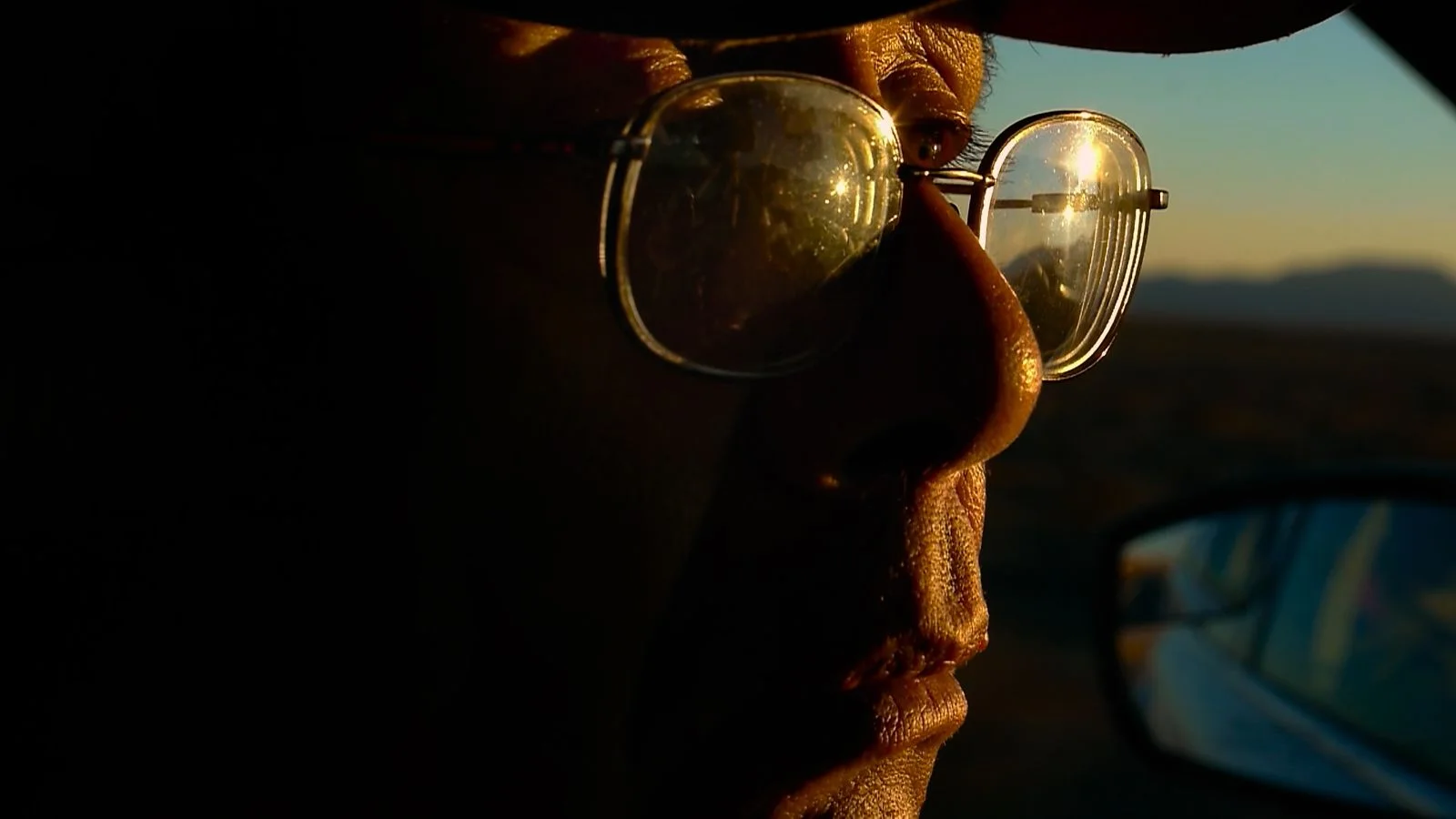
The opening minutes feel like hitchhiking without having asked where the car is going. We drive. We look. An old man at the wheel, glasses catching the setting sun, a road that won’t say where it leads. Who is he? What will he reveal? And why the odd feeling that he is the one watching us? Les Recommencements begins as a riddle, and has the good sense to stay one for a while.
A Meeting at the Laundromat
It should be said that this film owes its existence to a load of laundry. Isabelle Ingold and Vivianne Perelmuter, here on their sixth film as a duo, were travelling through Northern California with more camera gear than clean clothes. Inevitably, they ended up in a laundromat. A man came over to talk. He had noticed one of them wearing two-tone shoes and concluded, with a detective’s flair, that they were European. That man was Al Moon. Yurok on his mother’s side, Redwood Creek on his father’s, a volunteer for Vietnam in 1969, who came back changed, as people politely say of those who never quite came back.
Screenwriters have laboured for months to produce less novelistic opening scenes.
A Man Who Won’t Be Narrated
Al is not content to be the film’s subject. He is its co-writer. His voice-over, shaped with the directors from his letters and emails, was stripped of anything that sounded like self-justification.
What remains is spare, precise, sometimes funny, often sharp.
That is what saves the film from a familiar trap: the well-meaning documentary that files its protagonist under expected character and passes us the tissues. Al refuses the roles people pin on him, starting with that of History’s victim. He does lay himself bare, but bit by bit, at his own pace, and he decides what he keeps to himself.
There is one line he shared with the directors that sums up the singularity of his path: over there, in Vietnam, he had “the face of the enemy.” A Native American enlisted in the army that once fought his own people, sent to occupy another country, facing men who looked like him. Entire dissertations have said less.
By sharing his darkness and his wounds, he ends up confronting us with ours, the ills we keep hidden.
No sermon.
It works better that way.
The Salmon, an Unsung Hero
And then there are the salmon, announced in the very first seconds before they vanish from the narrative. They swim back into the film unannounced, like uninvited guests who end up stealing the show. We follow them underwater, filmed up close by directors who learned to swim alongside them. We watch them fight their way upriver to where they were born, hardwired to do so and yet driven by something close to stubbornness.
Who has not been struck by the sight of these fish battling the current?
They come back, even if it costs them their lives.
Their bodies will feed the next generation.
There is a karmic lesson here to digest, the meaning of life subtly distilled.
Birth and death are a passage, not a beginning and an end.
Their growing scarcity in Yurok rivers says a great deal about the state of the planet but the film does not stop at the diagnosis. The parallel with Al is never underlined in marker pen. We sense it, we guess at it, and we are free to make of it what we will. A man and a fish, each swimming against his own current: it took nerve, and above all it took the restraint not to explain it.
An Experience, Not a Lecture
This is not a documentary that explains.
It is a sensory experience, a road trip that sometimes turns hallucinatory, where light is scarce, often nocturnal, and Al’s face appears only in fragments.
The directors shoot in fixed frames, slightly off-axis, never blocking his horizon. He can step out of frame, come back, turn to them and call them out.
The camera rocks with the fishing boat when the river gets rough. Everything rocks, and so do we.
Much of this immersion comes through the ears.
The sound work is remarkable: the roar of the river, the deep rumble rising from its bed, the wind slamming against the tent, the pickup’s engine, the crackle of the fire, all recorded up close by the directors, who handle sound themselves, then sculpted in the mix by David Vranken and Nathalie Vidal. Liesa Van der Aa’s original score slips in without ever forcing the emotion, less a commentary laid over the landscape than a current rising out of it.
We do not just watch this journey, we hear it breathe. It is a film to see, and above all to hear.
The two filmmakers chose to live with him, to camp with him, to share the cold, the fatigue and the weather. It shows. The landscapes of the West are never a postcard.
They are inhabited places, shaped by volcanoes, the Gold Rush and wars.
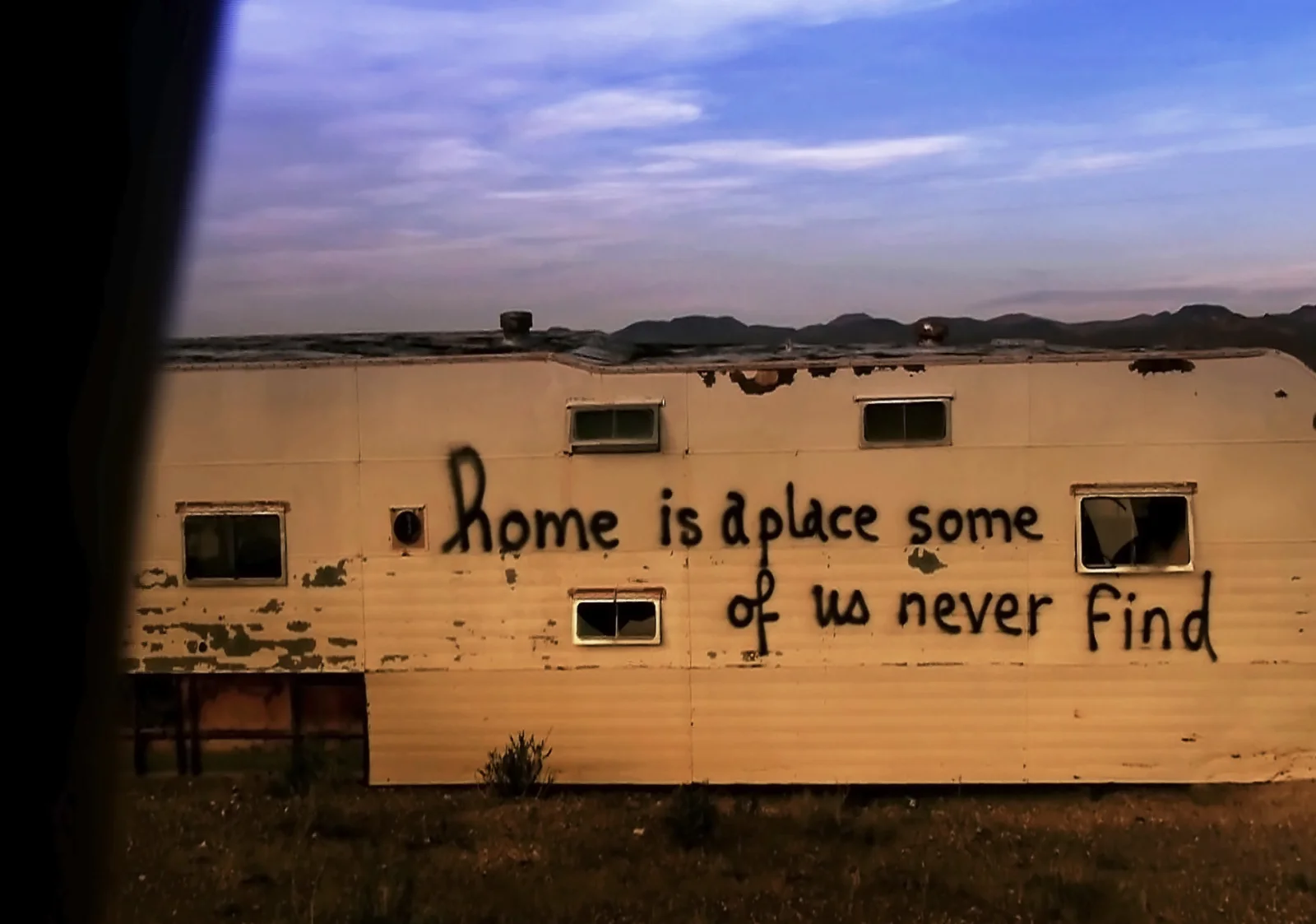
By the roadside, an abandoned trailer bears a spray-painted line: home is a place some of us never find. It could not be put better.
The film stirs political questions in us, but keeps them well away from slogans and partisan talking points. The America it crosses is fractured, exhausted in places, and yet threaded with lines of vitality.
Little by little, without our seeing it coming, a larger question settles in:
what is our place on this planet ?
Beginning Again
The title says everything, and nothing at all. How many times must we go wrong before we take a better path? The film offers no ready-made answer. It watches a man who refuses to be a prisoner of his past, who had made these words by Frantz Fanon his own:
“In the world through which I travel, I am endlessly creating myself.”
This reunion with his old battalion matters, that much is clear early on.
These men were not necessarily his friends.
What he is looking for there and what he finds, we will take care not to say.
Living, here, means surviving. It means keeping your balance amid the surrounding chaos, the way you hold your course in a rocking boat.
What will this old man leave to humanity ?
Perhaps simply this moment he offers, with disarming generosity, to two documentarians with an organic approach and, through them, to us.
Some images stay with you. You suspect they matter more than you think.
The salmon always come back.
Al Moon, for his part, begins again.